


Tai ar Y Cyd – Did We Need to Change the House Types? Lessons from Nant Y Coed
Updated: Jun 8

A planning application has recently been submitted for Nant Y Coed in Llandudno Junction for a 43 unit affordable housing development for Cartrefi Conwy
working with Savills ( Project lead ), Caulmert ( Engineering ) , Cadnant ( Planning Consultant ) and Siwdio Owens ( Landscape Architect ).
The plans are based on the Welsh Government’s Tai ar Y Cyd initiative, which offers standardised, low-carbon house types to help deliver quality affordable homes across Wales. The Tai ar Y Cyd pattern book gives housing associations and local authorities a range of homes designed for sustainability, easy construction, affordability, and resident wellbeing.

Standardisation has clear benefits, but creating a great place to live takes more than just arranging house types on a site. Every location is different, and Nant Y Coed is no exception. The site’s layout, housing needs, and terraces meant we had to adapt several Tai ar Y Cyd house types so they would work well together as a neighbourhood.
As a result, the development keeps the efficiency and sustainability of standardisation while also fitting the character and needs of its location.
Designing Beyond the Pattern Book
A key strength of the Tai ar Y Cyd approach is its flexibility. The standard house types offer a solid starting point, but they still allow designers to respond to the unique needs of each site.
At Nant Y Coed, we carefully reviewed each house type and found ways to improve how the homes fit together, especially in terraces. Some changes were small, while others involved bigger adjustments to roofs, proportions, and elevations.
These changes help create a more unified streetscape and give the development a clear identity.
TAYC 2B4P Narrow Dwelling
The most significant adaptation at Nant Y Coed involved the Tai ar Y Cyd 2 Bedroom 4 Person Narrow Dwelling.
Although visually similar to the adjacent Tai ar Y Cyd 3 Bedroom 5 Person Narrow Dwelling, the original 2B4P house type was slightly shallower in depth. When arranged within terrace formations, this difference created a misalignment between front and rear elevations.
Even though the size difference was small, it would have caused awkward steps in the terrace and disrupted the strong architectural rhythm we wanted.
To fix this, we increased the front-to-back size of the dwelling by 112mm. This lets the external walls of the 2B4P and 3B5P house types line up perfectly in semi-detached and terrace layouts. This small change makes a big difference to the quality and unity of the streetscape.
Additional changes include:
Introduction of pitched entrance canopies.
Removal of side-glazed entrance panels where bin storage is positioned adjacent to the front door.
Retention of the original wallplate and ridge heights whilst accommodating the revised building depth.
This is a great example of how small changes can make standard house types work much better together.

TAYC 3B5P Narrow Dwelling
The 3 Bedroom 5 Person Narrow Dwelling forms the backbone of several terrace groups across the development.
We focused on making this house type more consistent across terraces and giving the ends of the terraces a stronger look.
These adaptations include:
Introduction of pitched entrance canopies.
Removal of side glazed entrance panels adjacent to front doors.
Material variations to break down longer terrace runs.
Gable-ended variants where dwellings terminate a terrace.
These interventions help create these changes, making the streetscape more interesting and varied, while still keeping the familiar look of the original Tai ar Y Cyd design. Creating a Unified Roofscape.

TAYC 1B2P WALKUP APARTMENT
Another key design intervention involved the 1 Bedroom 2 Person Walk-Up Apartments.
The original Tai ar Y Cyd apartment building had a higher wallplate and ridge height than the nearby houses. This worked well for a standalone building, but made it hard to fit the apartments in with the 2B4P and 3B5P homes in mixed terraces.
To address this, we reduced both the wallplate height and ridge height of the apartment building so that its roofline aligns with the adjacent houses.
This change helps the apartments fit in better with the rest of the development and creates a smooth, continuous roofline that results in a more balanced and unified streetscape.
Additional apartment modifications include:
Removal of balconies.
Conversion of selected door openings to windows.
Introduction of pitched entrance canopies.
Introduction of hipped roof elements to soften the building mass.
Simplification of entrance detailing through removal of glazed side panels.
All these changes help the apartments blend smoothly into the wider neighbourhood.


TAYC 2B3P Accessible Bungalow adapted to a 2B4P
To respond to local housing requirements, a larger accessible bungalow was developed from the standard TAYC 2B3P bungalow.
The original single bedroom was enlarged to create a second double bedroom, increasing the occupancy from three to four people whilst retaining full accessibility standards throughout the dwelling.
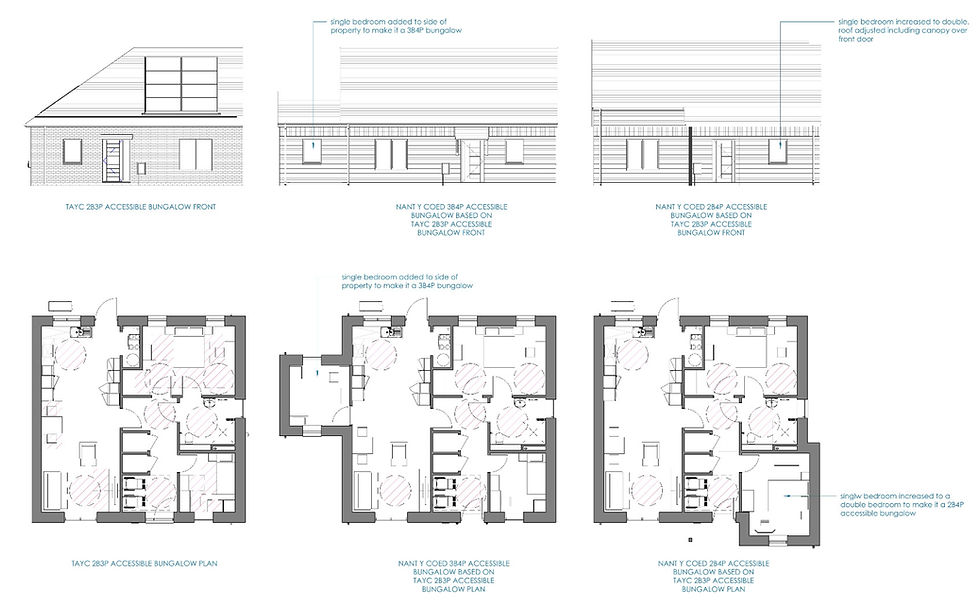
TAYC 2B3P Accessible Bungalow adapted to a 3B4P
A further variation of the accessible bungalow was created to provide a 3 Bedroom 4 Person family home.
This was achieved by introducing an additional bedroom to the side of the original bungalow footprint, accompanied by corresponding roof and frontage alterations.
The result is a highly adaptable, flexible family bungalow that adds more options to the types of homes available in the development.
TAYC 4B7P Family Dwelling
The largest family homes in the development have also been improved with several specific updates.
These include:
Increased roof pitch.
Raised ridge height to better relate to neighbouring dwellings.
Retention of the original wallplate level.
Introduction of pitched entrance canopies.
Removal of side glazed entrance panels where required.
These changes help the larger homes fit in well with the other house types and add to the overall character of the development.

Introducing the Tryweryn 1B2P Bungalow
The Tai ar Y Cyd pattern book offers many types of homes, but it doesn’t currently include a 1 Bedroom 2 Person bungalow.
To ensure Nant Y Coed delivers a balanced housing mix capable of meeting a broad range of housing needs, Creu Cartref added its open-source Tryweryn Bungalow to the Tai ar Y Cyd range.
The bungalow places a strong emphasis on accessibility, future adaptability and efficient use of space. It includes a generous double bedroom, open-plan living and kitchen space, adaptable bathroom arrangements and enhanced storage provision that exceeds minimum standards.
A key feature of the design is a knock-out panel between the bedroom and bathroom. This makes it easy to add direct access in the future if mobility needs change, helping residents stay in their homes longer and supporting ageing-in-place. The design also keeps ceiling areas clear for possible future hoist installations.
The bungalow shows our commitment to designing homes that are ready for future changes, not just meeting today’s standards. It also follows our “kit of parts” approach, so it can be built using traditional methods, panels, or off-site manufacturing without changing the main design. For more detail on this housetype read our blog here: https://www.creucartref.com/post/creu-cartref-s-tryweryn-bungalow-a-closer-look
or you can download the plans in .pdf and .dwg file formats here: https://www.creucartref.com/product-page/tryweryn-nungalow-1b2p-in-pdf-and-dwg-file-formats.
Adding the Tryweryn bungalow to the Tai ar Y Cyd house types means Nant Y Coed can offer quality single-storey homes for smaller households, while keeping a consistent look across the development.

Creating a Place, Not Just a Collection of House Types
The Nant Y Coed plans show that standardisation and placemaking can work well together. The types provide an excellent foundation for delivering high-quality affordable homes, but successful neighbourhoods emerge when those standard designs are carefully adapted to respond to their context.
At Nant Y Coed, this meant refining roof shapes, adjusting building depths, and matching ridge heights across terraces and apartments. The 112mm increase in depth for the TAYC 2B4P home and lowering the wallplate and ridge heights for the 1B2P walk-up apartments helped us create terraces and rooflines that feel thoughtfully designed. The inclusion of Creu Cartref’s Tryweryn bungalow demonstrates how carefully developed open-source housing designs can complement standardised house type suites and help address gaps in housing provision.
By working closely with Cartrefi Conwy, we aim to keep the efficiency, sustainability, and repeatability of the Tai ar Y Cyd approach, while also making sure the development fits its setting and community.
Now that we’ve submitted the planning application, we’re excited to move forward with Nant Y Coed and help bring a new generation of affordable homes to Llandudno Junction.


Comments