


Why does the Housing Industry Need a Delivery Ecosystem
Updated: 2 days ago

Building on our blog 'Creu Cartref Is Evolving: From Ideas to a Housing Delivery Ecosystem', we delve into why it's necessary in the industry.
Every housing project is unique. Every site has different constraints. Every community has different needs.
That will never change—and nor should it.
But does every housing project need to reinvent the way it is delivered?
For decades, the housing industry has accepted a process where each project assembles a new team, recreates technical information, develops details, procures products independently and solves many of the same problems encountered on the previous project.
Despite advances in digital technology, off-site manufacturing and modern methods of construction, much of our delivery process still relies on starting again.
The consequences are familiar. Programmes become longer. Coordination becomes more complex. Knowledge is lost between projects. Good ideas remain isolated instead of becoming common practice.
We spend an enormous amount of time recreating information rather than building upon it.
One Familiar Housetype. Four Technical Design Exercises.
We have experienced this first-hand.
The illustration below shows a Welsh pattern-book three-bedroom, five-person dwelling from the 1990s followed by four variations of essentially the same housetype that we have worked on.


One familiar housetype, four variations—each requiring separate Stage 4 information, costing and subcontractor coordination.
Although the homes share a recognisable arrangement, each required its own technical development and coordination exercise.
Beam-and-block floors. Timber frames. Services. Construction details. Specifications. The interfaces between the different subcontractor packages.
Much of this work covered ground that had already been covered before.
Individual differences may have been justified by the site, client brief or construction approach. But cumulatively, they generated separate packages of information for substantially similar homes.
The house layout was familiar. The work required to deliver it had to start again.
This raises a practical question: how much of that work genuinely needed to be project-specific, and how much could have started from an established, coordinated solution?
A Shared Starting Point Needs a Shared Delivery Process
Pattern books and standard housetypes offer an opportunity to address this.
Tai ar y Cyd’s 3B5P dwelling provides a current example. A shared design foundation creates the potential for consistency across multiple projects.
But how do we preserve that value as projects move through technical design, procurement and construction?
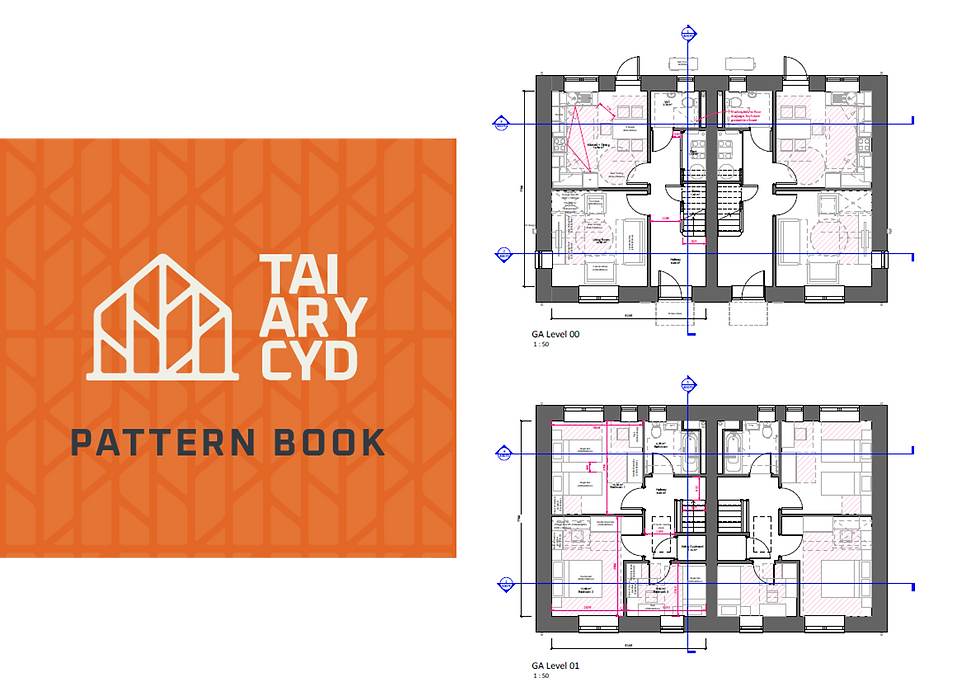
The opportunity is to carry a common design foundation through coordinated technical delivery.
If each project team independently develops the timber frame, coordinates the floors, positions the services and resolves the same junctions, a common housetype can still lead to multiple separate Stage 4 exercises.
Small changes can accumulate. Dimensions shift. Products are substituted. Service routes move. Previously resolved interfaces need to be reconsidered.
The question is how the industry organises the next layer of work so that the benefits of standardisation survive the journey to site.
Beyond Standard Housetypes
A successful housing project depends on much more than its floor plans.
It requires site assessment, feasibility, planning, technical coordination, manufacturer collaboration, procurement, construction support and post-completion learning.
When these activities operate largely in isolation, the delivery process remains fragmented.
An improvement a subcontractor develops may never reach the next design team. A difficult junction resolved on site may remain buried in project correspondence. A coordinated technical package may be archived at completion without becoming a useful starting point for future work.
Every completed project contains knowledge that could make the next project better.
We need a process to capture and apply it.
Where the Creu Cartref Ecosystem Comes In
At Creu Cartref, we are developing a Housing Delivery Ecosystem: a connected approach that supports projects from early feasibility through to post-completion learning.
A central part of that proposition is coordinated, repeatable RIBA Stage 4 technical information, developed with the people who manufacture, procure and construct the homes.

Different housetypes can benefit from a common approach to technical coordination, delivery and continuous improvement.
That technical package would bring together:
Coordinated BIM information.
Construction details and specifications.
Schedules and quantities.
Manufacturer and subcontractor interfaces.
Procurement information.
Defined options and rules for managing changes.
The value lies in how these elements work together.
A window opening, for example, needs to align with the timber-frame design, window specification, weathering details, fire requirements and installation sequence. Changing its size or position can affect several packages.
Resolving those relationships within a maintained technical package gives future teams a stronger starting point. It also makes the consequences of change easier to identify.
Site-specific adaptation and verification remain essential. Ground conditions, levels, exposure, planning requirements and project briefs still need appropriate responses.
The aim is to establish what can be reused, what can be varied and what must be checked for each project.
Open to Different Housetypes
The Creu Cartref Housing Delivery Ecosystem is not tied to Tai ar y Cyd or any single pattern book.
It is being developed to work equally well with Tai ar y Cyd designs, Creu Cartref’s own housetypes and housetypes developed by other architects, clients or housing providers.
The ecosystem provides the framework for coordinating technical information, connecting delivery partners and carrying knowledge between projects, whichever housetypes are used.
Tai ar y Cyd illustrates an opportunity. The principle applies across housing delivery.
Connecting the People Who Deliver
An ecosystem depends on people working together around clear responsibilities and shared information.
Housing associations, local authorities, architects, engineers, manufacturers, contractors, technology providers, asset managers, and residents all contribute knowledge that can improve outcomes.
Earlier manufacturer involvement can help establish workable dimensions, tolerances and interfaces. Subcontractors can contribute installation experience. Contractors can inform sequencing and procurement. Asset managers and residents can explain how homes perform in use.
For that collaboration to produce lasting value, the information needs ownership and governance: someone must maintain the common package, review proposed changes, and issue controlled revisions.
Project adaptations need to be recorded. Improvements need to be assessed before they become part of the shared baseline.
That is how collaboration becomes cumulative.
Every Project Should Improve the Next
The ecosystem we are developing extends from RIBA Work Stages 1 to 7, with coordinated Stage 4 information at its center.
Early decisions should benefit from delivery experience. Technical development should involve the supply chain. Construction should generate useful feedback. Experience in occupation should inform future revisions.
Over time, that creates the potential for fewer repeated coordination exercises, clearer procurement information and more dependable technical starting points.
We are developing this approach through our project experience and conversations with delivery partners. There is more to resolve, test and learn.
But the direction is clear.
Every project should leave behind more than a completed building. It should leave a better starting point for the next one.
That is why we believe housing needs a delivery ecosystem.


Comments