


What can housing learn from Dieter Rams?
Updated: Jun 10
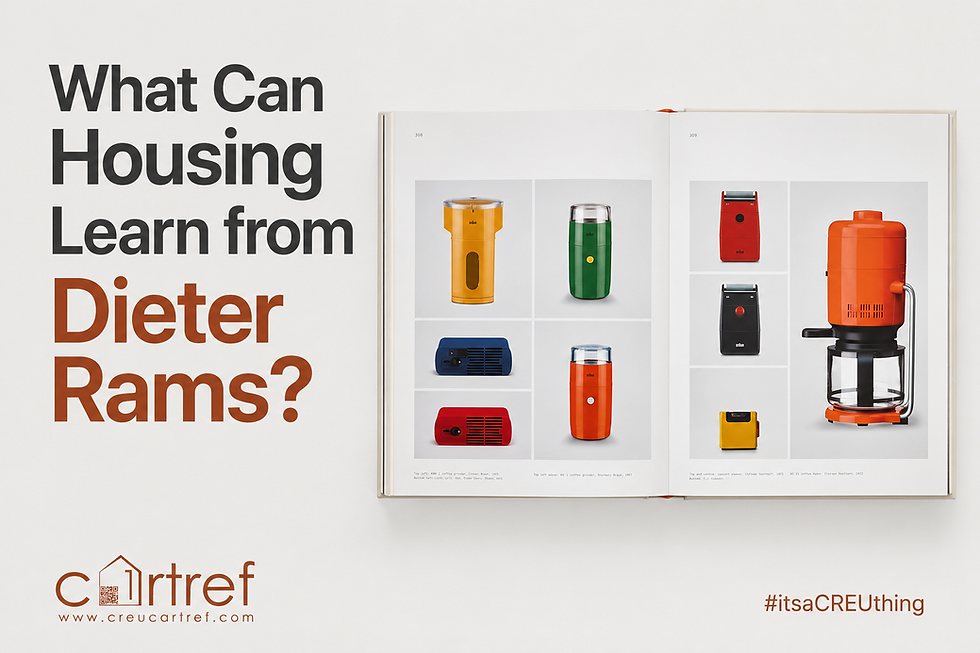

Dieter Rams graduated as an architect in 1953 and worked briefly at Otto Apel’s Architectural office in Frankfurt before starting a long-term relationship with Braun. He served as the German consumer goods company's head of design for over 30 years, from 1961 to 1995.
At Braun, Rams crafted a sophisticated, clear, and understandable visual language for his products, embodying one of his famously quotable statements:
"Simplicity is the key to excellence!"
In the late 1970s, Dieter Rams grew more intrigued by the wide variety of objects surrounding him, which he described as "a bewildering mix of shapes, colours, and sounds." Recognizing his influence as a designer in crafting this environment, Rams pondered an essential question:
"Does my design qualify as good design?"
Recognizing the subjective nature of good design, Rams sought to outline the essential principles he considered crucial in design and introduced his 10 principles of good design in a lecture in 1985:
"Some fundamental reflections on the essence of design which determined me and my fellow designers was summed up in ten simple statements a few years ago. They are helpful means for orientation and understanding. They are not binding. Good design is in a constant state of redevelopment - just like technology and culture" pg 353*
Outlined below are his 10 principles and the ways in which Creu's Cartef's design ethos addresses each.
Good design is innovative
"The possibilities for innovation are not, by any means, exhausted. Technological development is always offering new opportunities for innovative design. But innovative design always develops in tandem with innovative technology, and can never be an end itself."
Creu Cartref’s design philosophy uses the processes found in the industrialisation of construction. Instead of choosing standardisation over innovation, we use standard practices to boost efficiency and encourage new ideas. By saving resources that would otherwise go into custom solutions, we can invest more in research and development. This helps us improve our services and stay competitive as the industry changes. Balancing efficiency and innovation is central to both industrialisation in construction and to how we work.
Good design makes a product useful
"A product is bought to be used. It has to satisfy certain criteria, not only functional but also psychological and aesthetic. Good design emphasises the usefulness of a product whilst disregarding anything that could possibly detract from it."
Houses are built from a series of rooms that come together to make a home. At Creu Cartref, we focus on standardising and delivering well-designed, coordinated rooms so that every home is consistently practical and comfortable.
We include features like an air source heat pump cylinder and mechanical ventilation heat recovery units, along with their ductwork and pipework, without taking away from the resident's storage space or amenities.

pg 65*
Good design is aesthetic
"The aesthetic quality of a product is integral to its usefulness because products we use every day affect our person and our well-being. But only well-executed objects can be beautiful."
Creu Cartref homes have a simple, elegant style and feature carefully crafted designs that add to their beauty. Every detail is planned and finished with care, so we can focus on making sure each project includes empathy. This way, the people who live in our homes get the full benefit of a design and building process that is made just for them.
‘Anyone can build a building that protects people from the heat, sun and cold. What I am determined to do is to make a stage where people can be sexier and more brilliant, the place where they can awake smarter’ philippe stark
Good design makes a product understandable
"It clarifies the product's structure. Better still, it can make the product talk. At best, it is self-explanatory."
Creu Cartrefs homes are designed with Modern Methods of Construction (MMC) in mind. This approach moves away from traditional on-site building and instead focuses on assembling pre-made parts at the site. When these parts are more standardized, the industry can produce them more efficiently and take advantage of the cost and economic benefits that MMC offers.
Cartref's homes have a straightforward structure, with clear load-bearing walls and service routes. This makes manufacturing and assembly easier, and it also helps with future maintenance or changes.

pg 203*
Good design is honest
"It does not make a product more innovative, powerful or valuable than it really is. It does not attempt to manipulate the consumer with promises that cannot be kept."
Creu Cartref’s design focuses on building a consistent platform that supports future innovation. Our houses can be built with any construction method, such as traditional brick and block, panelised systems like light gauge steel or timber frame, fully factory-made modular systems, or even 3D printing. No matter which method is used, choosing Creu Cartref’s house types means you get the same bathroom, lounge, bedroom, and other spaces every time.
Good design is unobtrusive
"Products fulfilling a purpose are like tools. They are neither decorative objects nor works of art. Their design should therefore be both neutral and restrained, to leave room for the users self expression."
Creu Cartref’s design approach is intentionally subtle. The goal is to create a unified platform that lets people express themselves, both inside and out.
It does not set rules for:
how the building is constructed.
the interior layout, such as kitchens, bathrooms, and similar spaces.
which manufacturers supply the plant and equipment. However, it does set aside space for these items and their necessary service routes.
the look, structure, or performance of the building’s exterior. Features like finishes, insulation, and air tightness can be adjusted to fit each project’s goals.
What it does provide is:
a reliable platform that ensures the end user gets a consistent result every time.

pg 309*
Good design is long-lasting
"It avoids being fashionable and therefore never appears antiquated. Unlike fashionable design, it lasts many years - even in today's throwaway society."
What might the construction industry look like in 20 or 30 years? Could we be working remotely, living more nomadically, or working from anywhere in the world? Will permanent homes still make sense? How can we design for a digital generation shaped by Minecraft, Fortnite, and the COVID era? Will people want more flexibility in where and how they live and work? Should homes be easy to expand or shrink? Is it realistic to stay in one place for a lifetime? Could all construction eventually use off-site modular methods?
Modular construction has obvious advantages, but it will take time before it becomes the norm. Creu Cartref is working on a solution that can be delivered modularly in the future. This approach helps move from traditional building methods to more modern, fully modular techniques, while still offering the same types of homes and spaces.
Good design is thorough down to the last detail
"Nothing must be arbitrary or left to chance. Care and accuracy in the design process show respect towards the consumer."
The idea of a "kit of parts" is central to industrialising construction. Similar to putting together furniture from ready-made pieces, this method uses standard building elements and processes to form a complete product. By dividing projects into modular parts that can be easily repeated, Creu Cartref can save costs, improve over time, and make their results more consistent and reliable.

appendix timeline*
Good design is environmentally friendly
"Design makes an important contribution to the preservation of the environment. It conserves resources and minimises physical and visual pollution throughout the lifecycle of the product."
By standardizing the main features of Creu Cartref's house types, we can focus more on improving their environmental impact during construction and delivery. This includes:
Material Selection: Use low-carbon or recycled materials.
Efficient Design: Optimize building designs to use fewer materials.
Modular Construction: Use modern construction methods to cut down on waste and emissions.
Local Sourcing: Get materials from local suppliers to reduce transportation emissions.
Life Cycle Assessment: Carry out life cycle assessments to measure and lower the embodied carbon in building projects.Standardizing the core deliverables of Creu Cartref's house types provides the opportunity to concentrate on enhancing the environmental aspects of their construction and delivery, including:
Good design is as little design as possible
"Less, but better - because it concentrates on the essential aspects, and the products are not burdened with in-essentials. Back to purity, back to simplicity!" pg354*
Creu Cartref homes and apartments use just nine interchangeable room modules. Each module is fully designed and coordinated in our 3D software. Like the manufacturing industry, we create detailed prototypes, coordinate every part of the product, and test design decisions before starting construction.
By adotping Creu Cartref's house types there will be:
Less rework
Less arguing
Less inconsistency
Less misunderstanding
Less quantity of information
but
Better communication
Better understanding
Better awareness
Better relationships
Better results
Better environments
Better affordability

pg 59*
"Less but better has become Dieter Ram's ultimate motto for change." pg 356
"By all means reduce, says Rams, but only in the service and utility and the user - not for the sake of aesthetic reasons alone. Reduce quantity, superficiality, greed, waste and excess and at the same time increase: increase humility, quality and the effort to achieve better products, better design and thereby a better world: 'There must be millions of less things, less words, less gestures, less everything. But every word and every gesture will become more valuable. If we can put it all into perspective we will need less things as a result." pg 356*
*Images and extracts have been taken from the book Dieter Rams: As Little Design as possible


Comments